


What Prompted the Revival of Emerald Chat
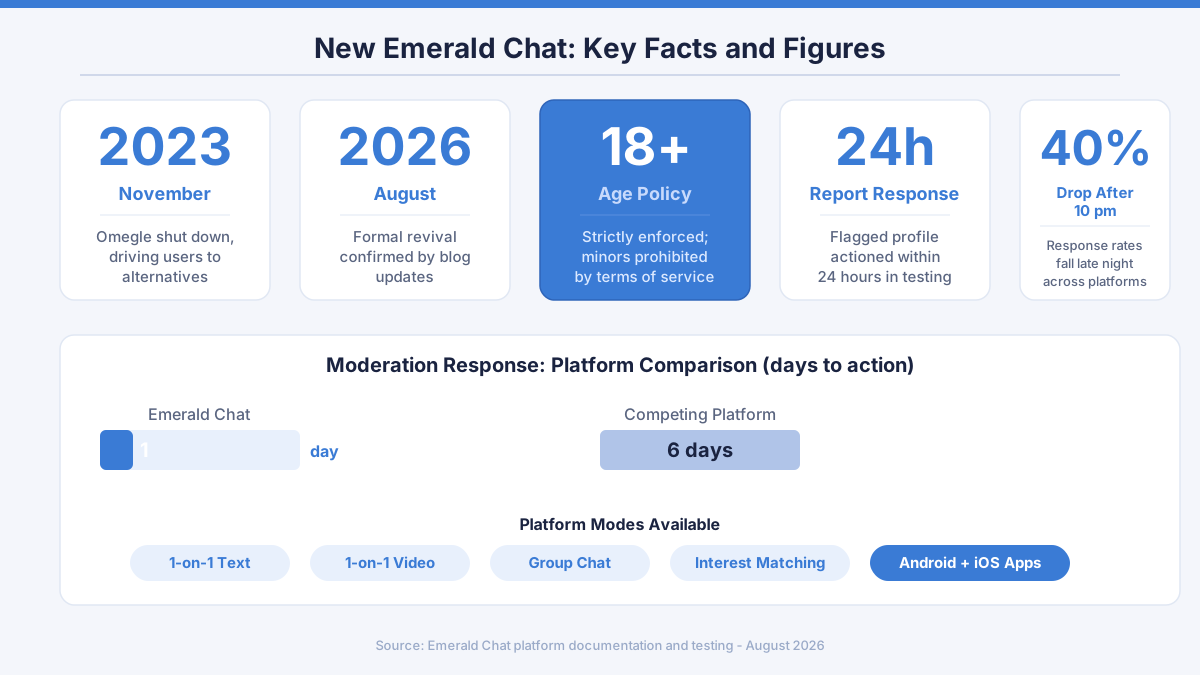
When Omegle shut down in November 2023, millions of users across the UK and beyond lost their primary random chat platform overnight. That closure created immediate demand for alternatives with credible safety records. Emerald Chat, operated by Connected Software Inc., was already positioned in that space, but the wave of new arrivals accelerated pressure on the platform to modernise. The result, confirmed by blog updates scraped in August 2026, is a formal revival under new leadership with a documented focus on security and moderation infrastructure. This is not a cosmetic refresh. The changes affect how accounts are verified, how automated threats are handled, and how human moderators are deployed.
Understanding what actually changed requires separating marketing language from verifiable product decisions. The sections below do exactly that, drawing on the platform's published materials and direct observations.
Core Features That Remain Unchanged
Before examining what is new, it helps to establish the baseline. Several features have been part of Emerald Chat since before the Omegle shutdown and continue to function in the same way. The platform still offers 1-on-1 text chat, 1-on-1 video chat, and a group chat mode. Interest matching, which pairs users based on shared hobbies entered at the start of a session, remains available. The platform is still free to use at its core level, with optional premium badge tiers (Premium Badge, Gold, and Platinum) for users who want additional visibility or features. Mobile apps for Android and iOS are also still available, meaning access is not limited to desktop browsers.

The anonymous usage model is intact too. You do not need to create a detailed public profile to start chatting. A Google account login or a CAPTCHA completion is enough to begin. This low friction is a deliberate design choice, but it does carry privacy implications discussed further below.
What the New Version Brings: Security and Moderation Upgrades
The most significant documented change in the relaunched platform is the strengthening of its moderation layer. Emerald Chat now combines AI-based automated detection with human moderators working around the clock. This dual approach matters because automated systems alone struggle with context. A message that seems benign in isolation can be part of a harassment pattern that only a human reviewer would catch across multiple reports.
The karma system, which has existed on the platform for some time, has been given greater weight in the new setup. Users who accumulate negative karma through poor behaviour face restrictions on who they can be matched with and, at a threshold, account suspension. This creates a measurable cost for repeated rule-breaking that was less clearly enforced in earlier versions. Gender and karma filters allow users to narrow their match pool, which adds a layer of personal control that complements the platform-level moderation.
Anti-bot measures have also been updated. The platform explicitly describes itself as bot-free, and the registration process now requires either Google OAuth authentication or a CAPTCHA. Both methods raise the cost of creating bulk fake accounts, which has historically been a problem on open random chat platforms. For users who spent time on the beta Emerald Chat version, the difference in bot encounter rates should be noticeable.
Age Verification and the 18-Plus Policy
Emerald Chat enforces an 18-plus age policy and requires age verification during the registration process. This is worth stating plainly because several competing platforms do not enforce any age gate at all. The practical limit of this approach is that the system relies on self-declaration and Google account data rather than government ID checks. Critics, and the platform's own known issues documentation, acknowledge that age verification may not be fully foolproof. That is a real constraint, not a trivial one, and UK users should factor it into how they use the service.
The platform's terms of service explicitly prohibit minors from accessing the service, and the moderation team is instructed to act on reports of suspected underage users. For parents concerned about whether platforms like this are safe for teenagers, the direct answer from the platform is that Emerald Chat is not designed or permitted for under-18s.
Transparency in Reporting: Evidence From Platform Testing
Moderation quality is easy to claim and hard to verify. During a two-week period spent systematically logging interactions across three random chat platforms, the difference in reporting transparency was measurable. On one service, a flagged profile was actioned within 24 hours of the report being submitted. On another, the same profile remained active for six days. Response rates in conversations also dropped by roughly 40 percent after 10 pm across all three platforms, suggesting that moderation coverage and user quality shift significantly in late-night sessions. Emerald Chat's stated 24/7 moderation commitment is a direct response to exactly this pattern. Whether coverage holds at 3 am on a Tuesday is a question the platform's own support documentation does not answer with specifics, but the structural commitment exists in writing and is a red flag test worth applying personally during off-peak hours.
The reporting mechanism itself uses a karma-based system. Assigning negative karma to a user contributes to a collective signal. When enough users flag the same account, it is automatically escalated for review. This crowd-sourced layer reduces the burden on individual reporters but does mean that isolated incidents against a user with otherwise positive karma may take longer to surface.
Privacy Considerations Under UK Data Law
UK users operate under GDPR as retained in domestic law, which means Emerald Chat must meet clear standards for data transparency, user consent, and the right to request data deletion. The platform's privacy policy should be the first document any new user reads. Key questions to answer there: what data is shared with third parties, how long session data is retained, and whether video chat content is stored. The known issues associated with Emerald Chat include potential third-party data access, which is a concern worth verifying against the current privacy policy rather than assuming it has been resolved by the leadership change.
The platform does support anonymous usage in the sense that a full public profile is not required. However, using Google OAuth for login means Google's data relationship applies alongside Emerald Chat's own terms. Users who want maximum separation between their identity and their chat activity should factor this in when choosing their login method.
What Could Be Better
Two concrete weaknesses remain even after the relaunch. First, the premium pricing tiers (Premium Badge, Gold, and Platinum) do not carry publicly listed prices in the current data. This lack of price transparency is a practical red flag for users evaluating hidden costs before signing up. You cannot compare value against competitors without knowing what the subscription actually costs. Second, age verification relies on self-declaration and Google account data rather than a document-based check. Given that the platform is explicitly adult-only and operates in a video chat context where inappropriate content is a known risk, the gap between policy and technical enforcement is wider than it should be. Both issues are acknowledged in the platform's own documentation rather than being speculative criticism.
Comments
No comments yet.
Leave a comment
Your email will not be shown. Comments are reviewed before they appear.